
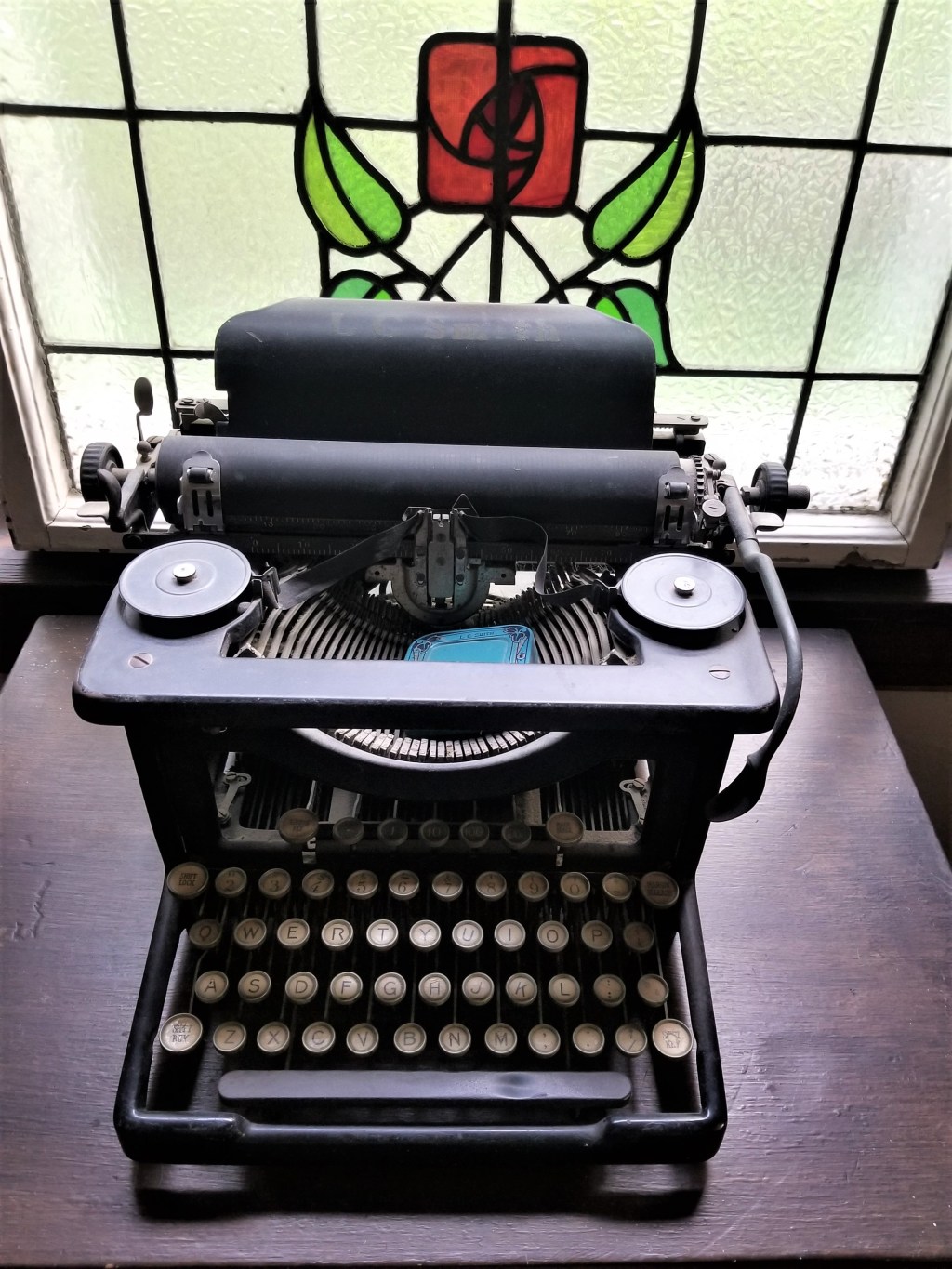
When I set out to write my first novel, I wrote it with pen on notebook paper in a three-ring binder, which I had on hand because I needed them for sixth grade. My family didn’t own a typewriter and home computers hadn’t been invented, but I took a typing class in junior high school—the only kid in class who was learning to type so she could type her book. My parents gave me a portable typewriter as a birthday present, and I started composing on it, though I littered the floor with pages I couldn’t throw away because I might need them.
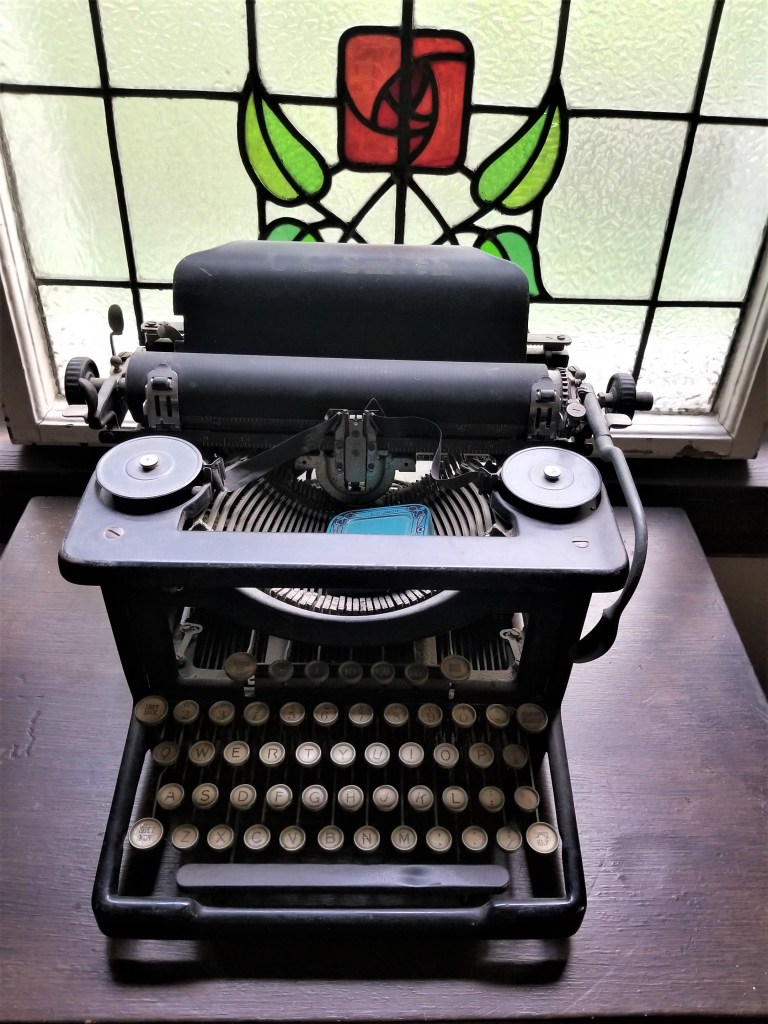
My grandfather, Cecil J. Marks, acquired this typewriter in the 1920s and used it his entire life.
Portable typewriter – a self-fulfilling prophesy
I had never traveled anywhere except on family car trips, and yet my typewriter did need to be portable. It went with me to Mexico, where I worked for a nonprofit agency following my freshman year of college. That autumn, so I wouldn’t exceed the airplane’s weight allowance, my typewriter stayed home while I spent a semester in Great Britain. In the next year I zigzagged between the west and east coast of the U.S, from California to Massachusetts to Washington to Rhode Island. I zigzagged across the country by bus, bringing with me everything I owned: A trunk of clothing, a box of fantasy paperbacks, a green Sekine ten-speed bicycle, and my typewriter.
I used the typewriter until a couple of years after I graduated from college. When it was so obsolete I could no longer get ink for it, I bought an Apple IIC computer and a dot matrix printer. I had college loans to pay, was desperately poor and had no access to credit, so my mother helped me buy the computer and I paid it off at fifty bucks a month. For the next five years I wrote, living in my parents’ orange orchard, every three weeks spending four days irrigating the trees and repairing the irrigation lines. In junior high school I had been sent to the school counselor because I was writing a novel during math class, and eighteen years later DAW published my first fantasy novel. Then they published four more, and I replaced my Apple IIC with an Apple IIE.
I bought my first laptop just before another cross-country trip, this time to attend graduate school in Massachusetts, where I settled down, became a college composition teacher, and published four more books. By then I had reverted to writing by hand on paper—gel pens, blue ink, college-ruled glue-top pads. I was using computers all the time, and book manuscripts didn’t need to be on paper anymore. So why was I writing by hand?
Why Write by Hand?
Well, it’s complicated. Circumstances had forced me to write in weird places—on the subway, in my office between appointments with my students, in hospital and doctor waiting rooms (my wife, disabled by a rare disease, received treatment several times a week, and was frequently hospitalized), and—still my idea of heaven—in a tent in a campground on the coast of Maine. Also in coffee shops, of course, on non-teaching days. After I switched from teaching to administration and moved out of town, I wrote on the commuter train. A clipboard and a pad of paper were easy to carry, and with them I could write anywhere.
But more important than simplicity, I write by hand for quality: the quality of my writing and the quality of my writing experience. When composing on the computer, my engagement with the text is different. I’m focused on the message and the plain meaning of my words. I can quickly produce a lot of language when I compose on computer, but there is always a distance between me and the thing I’m writing, as if the computer causes some kind of signal interference. When handwriting on paper, I am more creatively engaged, and the experience is imaginative and vivid, as if I’m embedded in the created world. Writing by hand is simply more fun.
First draft to second draft, and so on
To get to a second draft, I have to type the first draft. I try to type each chapter as soon as it’s finished, because the tedium of typing an entire book is unendurable. Then I print it and revise it by hand, which renders the first draft unrecognizable. Revising, for me, is when the real writing happens. I throw away most of the first draft, and retype the manuscript a few more times. All this is not wasted effort, because without the first draft I couldn’t write the second draft, and without the second I couldn’t write the third.
Relying on the brainy part of my brain
So far, I’ve written about 12,000 words of the current first draft, and have a lot of words to go. When I type a chapter, I see that it’s not very good, but it’s full of potential. While part of my brain continues to push the first draft forward, another part of my brain—the brainier part—is quietly mulling over the problems of style and composition, plot and character, that are unique to this particular book. I’ve assigned these problems to my brainier self, and so I don’t consciously think about them except when I’m on a long drive, or writing a blog post. The rest of the time, I’m just getting the words onto the page. I don’t expect myself to write well, because that would cause the machinery of this ridiculous contraption to grind to a halt. I just keep telling myself I’ll fix the overloaded, nonsensical, inconsistent mess later.
Ridiculously labor-intensive this process may be, but it works. And that’s why I write by hand—because it works.


 Laurie J. Marks
Leave a reply to Laurie Marks Cancel reply