
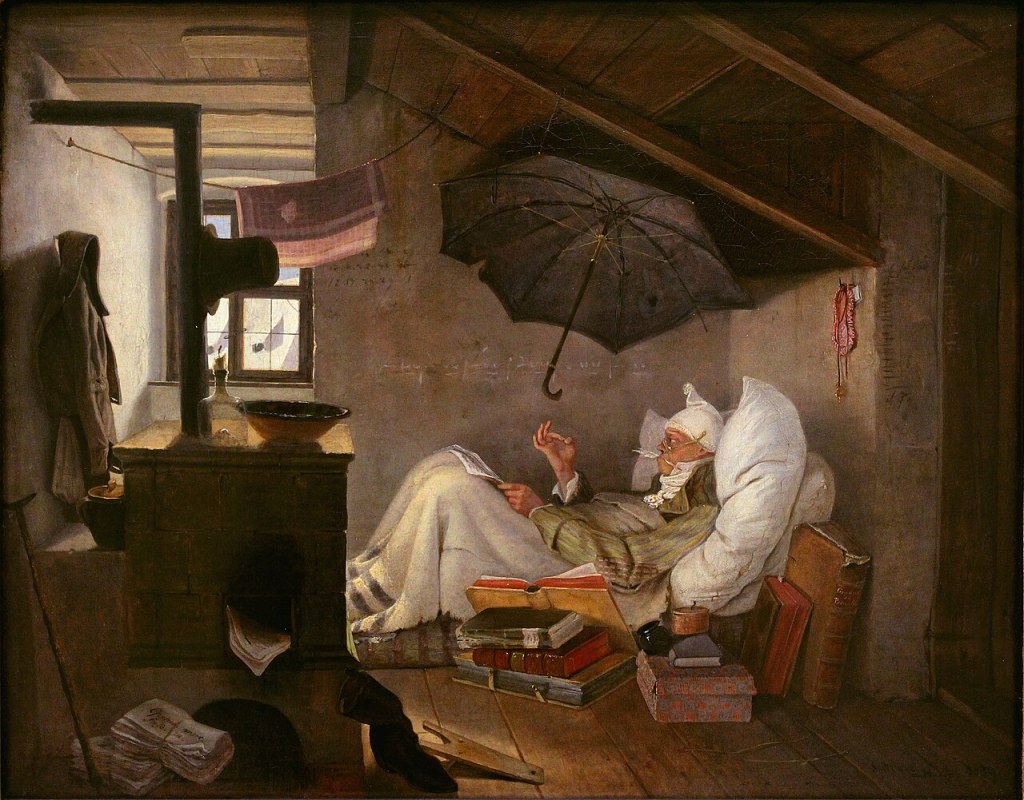
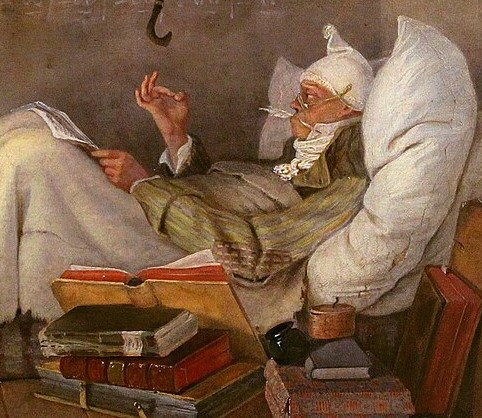
In an 1839 painting by Carl Spitzweg, Der Arme Poet (The Poor Poet) a skinny man in a night cap with a quill pen in his teeth is counting the meter of a poem with his fingers while lying on a mattress on the floor surrounded by books. Snow lies on the rooftops (visible through the window) but he has no fire in his stove. He does have an open umbrella attached to the rafters, which presumably diverts water from the leaking roof. I stumbled across this image when I Googled “garret.” And I’m not sure why I suddenly needed to get a definition of that miserable attic room where struggling writers and artists reside, but perhaps it’s related to the fact that with a high of 44 degrees (6 Celsius) we haven’t turned on the heat since last night because the system is being serviced today. (FYI for people accustomed to modern heating systems, we have steam heat, which means a boiler in our basement literally boils water so steam will rise through our radiators to warm up our rooms. For the system to be worked on, it has to be cold so the steam reverts to water and returns to the boiler.)
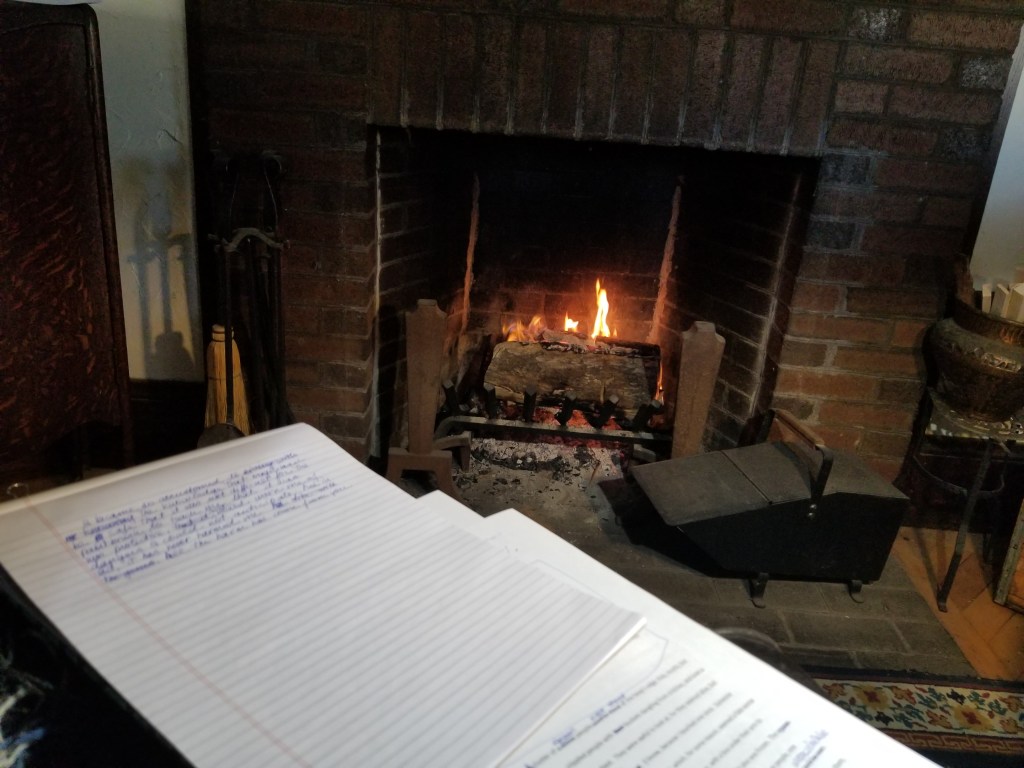
So I wrote while dressed in several layers, wrapped in the Scottish rug from my 1976 semester abroad, and considering whether I should take a hint from the poor poet and put on a hat. However, I was better off than him, because at least I had a fire in the fireplace. Though when that fire set off the smoke alarm I had to air out the room by fanning cold air through the front door. Oh, the irony.
As you know, Bob…
The first few chapters of draft 1 were world-building exercises, some thirty pages of telling and not showing, typical when a writer is punching her way through the steel doors of a story. Thus I saddled myself with three very problematic chapters. In my last post I mentioned the limbo document in which I had parked material I’ve removed and intend to use in some way. This week it became necessary for me to flail through that project. The original limbo-ized Chapter 3 illustrated the survival precept “Take Care of Your People,” but actually lays the groundwork for the essential dilemma of the book. Therefore, I don’t get to leave this crap material in limbo, much though I want to. Either I have to transform the crap mess, or I have to accomplish the same goals in a completely different way.
I had no idea how to make this crap draft sit up and behave like a decent chapter, so I went into the document on my computer and moved paragraphs around until they formed the rough shape of a narrative, printed a new copy, and then re-read my revised Chapter 2, to remind myself of any dangling story threads I could grab hold of in the subsequent chapter. I noticed that in Chapter 2 I was pointing at some legal information that I’ve never properly explained, which would probably be aggravating to people who expect their fiction to make sense, so I drafted a conversation that’s composed of correspondence between Painter and her advocate. (Conversations are good for serving multiple purposes, in this case to reveal something about Painter while also conveying some facts she and the reader need to know.)
So I discovered that I couldn’t actually make the legal situation make sense without turning this into a completely different book, and instead I wrote my way into an explanation that makes it acceptably nonsensical, in a “that’s just the way we do things here” sort of way. I think I can rely on fantasy readers to accept this dodge, but I may revisit this problem later, perhaps enlisting the help of a smarter writer than me. (Rosemary Kirstein, of course.)
Limbo Goes Viral
It was a pleasant break to write some new material rather than pound away at the frustrating business of fixing my unsuitable first chapters. But now I simply had to work on the limbo material. Here’s an odd thing I’ve noticed in my students and myself. If I’ve written something one way, that approach can keep taking over like a virus, regardless of my desire for it to be completely different this time. Relying heavily on my goddam stubbornness, I filled a page of my college-ruled glue-top pad with crossed-out sentences that seemed like they would work but then became the thing I was trying to replace. Exasperated, I took my printout and physically crossed out the paragraph I was trying to rewrite. (For you writing geeks out there, that offending paragraph had too much narrative distance, and the voice of the narrator kept telling her reader what to think rather than presenting the events and letting them speak for themselves.)
Crossing out the paragraph shouldn’t have resolved anything, but writer’s brains are mystifying. I rapidly turned the paragraph into a four-page dramatic scene in which multiple people were working together to save a person’s life. I used the scene to introduce several essential characters and their habits and ways of relating. One in particular, Painter’s friend, in the first draft is just a cardboard character who happens to be present when Painter needs someone to talk to. But in this revised scene she was revealed as an interestingly calm and competent person, burdened by her own relationships, values and life history. She’s three-dimensional enough to carry a subplot, though I’m not sure whether subplots are even possible in a first-person narrative. (I’ve been writing fantasy novels for 54 years, but I have a lot to learn.)
I realized that what this character and Painter have in common is their determination to make things better and not worse, and in this scene they recognize that determination in each other and become friends. So now I understood something about each of them that I hadn’t realized before.
Struggle, then Insight. Repeat.
All my writing experience is good for something. I know that cycles of struggle and insight are predictable, and that neither phase will endure for long. Writing is hard, exhausting, and dispiriting, then suddenly it’s easy and I feel like I can do anything, and then it’s a laborious grind again. This cycle reminds me of a bicycling class I took in high school, when once a week we’d ride our bikes over San Marcos Pass (elevation 2200 feet). I was the least fit person in the class, but I had accomplished a lot by grim persistence in my 16 years, so climbed the pass every week, one pedal-stroke at a time. Then I’d turn around and whoosh down the mountain, overtaking one car after another. Thank goodness nothing catastrophic plowed me into the tarmac.
I’ll finish revising Chapter 3 tomorrow and move on to Chapter 4: more pounding and sighing, gasping and laughing. At least I’ll have heat.
I’m not much of a capitalist. I don’t event want to try to earn money from this blog. But I am hoping to recruit new readers, so if you’re looking for something to read, perhaps you could check out my novels here.
 Laurie J. Marks
.jpg)
Leave a comment