
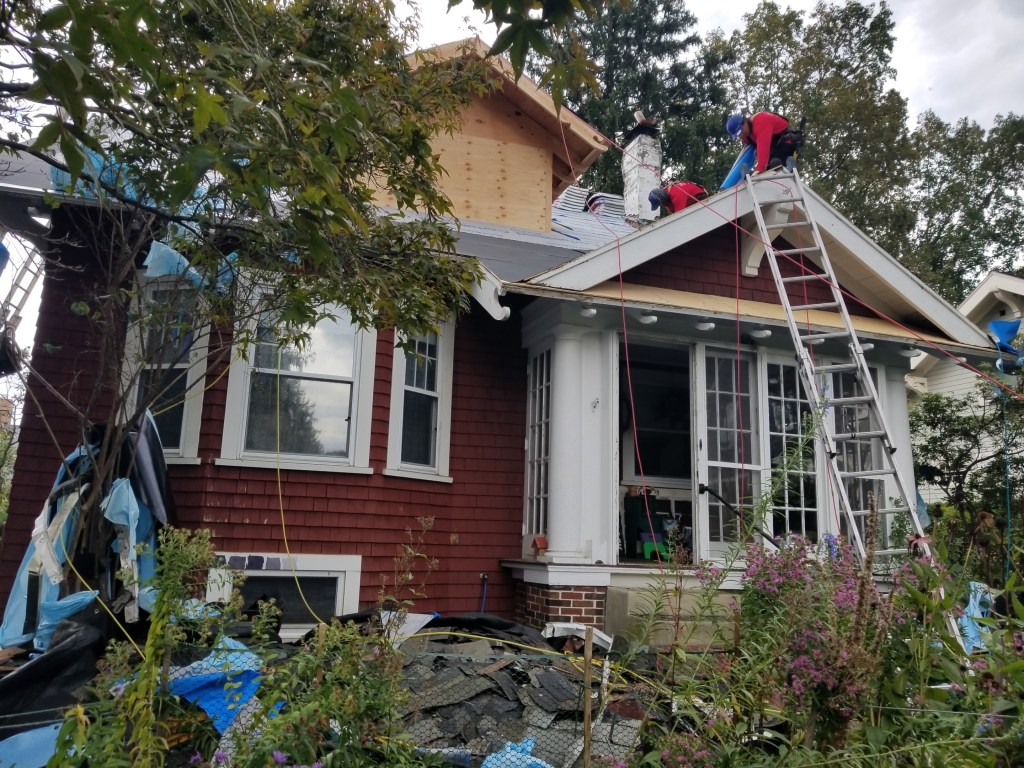
At 7:30 AM, I was still in bed when loud thumping on the roof informed me that the roofers had arrived. Within two hours they had stripped off the old roof, and their ladder lift was steadily hoisting sheets of plywood for sheathing. By then, Serendipity (aka Seri, the corgi) had more or less accepted this inexplicable universe in which THINGS KEPT DROPPING and there were VOICES and NOISES. Meanwhile, despite the racket and frequent breaks to calm down dog and wife, I managed to put together the commentary linked below. So long as I have enough coffee my writing brain keeps on chugging.
I pause here to point out that reroofing offers a decent metaphor for revision: Ripping everything apart, hauling away a monstrous load of trash, incorporating a new base, covering it in layers of new surfaces.
What I Did this Week
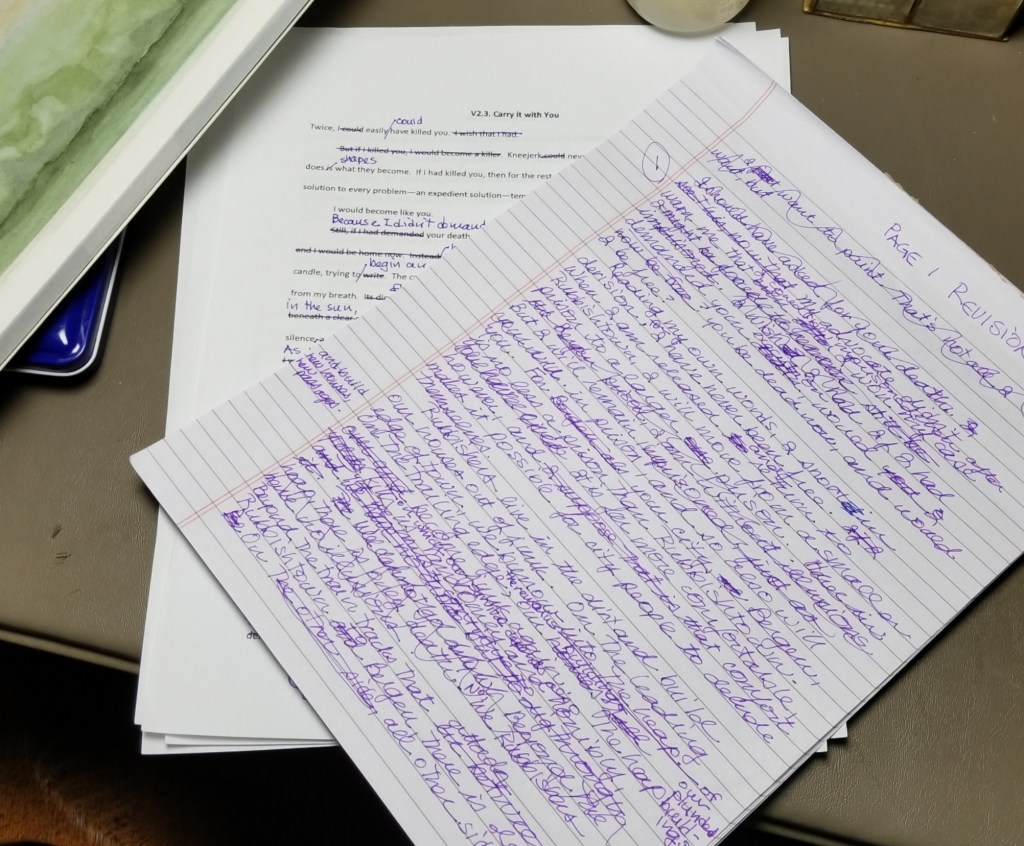
The editing brain can be a real jerk while the creative writing brain can be fragile, and the two modes interfere with each other in ways that can lead to paralysis. I try to keep these processes separate, though I do correct, change, and fix the text while I’m drafting it. In “My Words Are Rocks,” also on the topic of revising my book’s first page, I noted that I was having trouble getting myself to revise rather than edit. To reset the switch from “edit” to “create,” I thought a writing exercise involving detailed description would be helpful, because for many people, close observation engages the creativity engine. It was raining, so I used a random image generator to find pictures, which I then described in words. After a while, I wrote three alternate first pages, and discovered that no matter how different I tried to make them, sooner or later I started explaining the story situation (that the narrator is writing because she is required by a judge to do so).
Of course! (The light comes on.) My options for starting this book are limited by the story situation, because the narrator, Painter, has a specific assignment and she does not intend to tell her story. For her to begin with an anecdote, when she’s supposed to write an instruction, makes no sense. However, instruction is not particularly appealing or revealing, and definitely isn’t fun to write. But I could make the first page be Painter’s reaction to and objection to the assignment—which can include narrative and character information.
Writing alternate versions of page one allowed me to think more clearly about what belongs on that page of this book, and why. Writing is thinking, and writing while thinking about writing…well, it certainly could be a knotty mess, but for me it sometimes yields insight.
I re-read the four versions of page one to see what I liked and didn’t like about them. After all this work, I still preferred the original version. (It happens.) But each of the alternates had features that seemed worth keeping: a detailed description of the narrators immediate environment, a courtroom scene with a glimpse of the antagonist an abbreviated world atlas/history, a couple of rants.
So I decided to combine features of the three alternate versions to create a new first page that leads into the original first page, which now is the second page. At the link below, which goes to a Google Doc, you can see the result. In this one document I’ve included all four versions, color coded, with the unused text crossed out. As I pieced it together I added some new bits, which is the non-highlighted text. Then, to make it extra exciting, I added marginal comments in which I attempt to explain my thinking. The resulting document may not be fascinating, or even readable, but here it is; make of it what you will.
There Will Not Be a Quiz
And here is a digest:
- In-depth: Everything serves at least two purposes. A description of the environment reflects the character’s emotional state; a wry observation helps the reader to learn how to read the story, action moves the story forward and reveals character. (I’m not sure I can continue this multi-purpose writing, but I will try.)
- Describe: Concrete, specific language helps me to shift from telling to showing. If at any point I feel distant from the story, I need to tell about it less and instead use description to make it real. Describing gets me inside the story, where I need to be. If I’m inside it, so is my reader.
- Richness: Humanize the characters; create a multisensory world. Doing these things is essential on the first page and throughout the book, but I tend to shortcut them in a first draft.
- Small picture/big picture: Not necessarily on the first page where it is now, but soon, I’ll set the scene: not just the immediate surroundings, but also where that place fits in the world. Similarly, I’ll try to make the story present contain the past and imply the future, and load the characters down by their life history and their hopes (or lack of them) for the future.
I’m escaping the first page for now, but I’ll consider and discuss these topics in more depth in future posts, for I’ll probably keep bumping into them as I revise this book.
 Laurie J. Marks
Leave a comment