
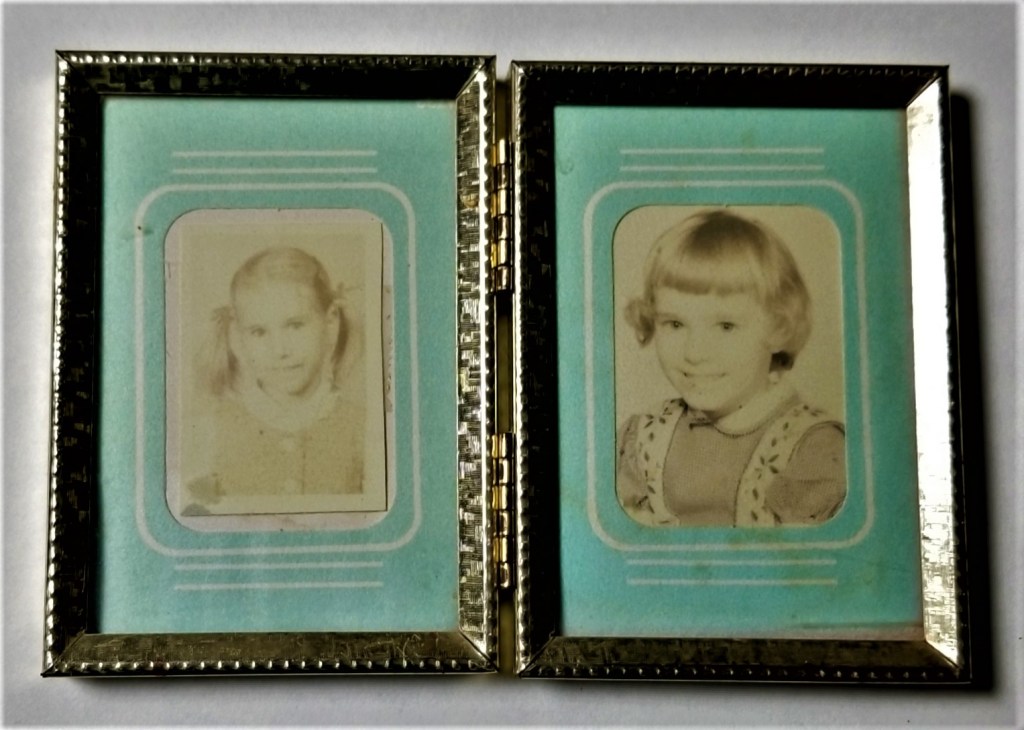
During the seven years we have owned our house, Deb and I have become close friends with our neighbors, a heterosexual couple our age, Iris and Dave. Last week, Iris said that she thought she had spotted Deb at a nursery, but it wasn’t Deb—just someone who shared her stylist.
This was a good joke. Iris knows that when Deb dresses up, she wears trousers, a button-down shirt, a tie, and a blazer. In a plant nursery, however, Deb would be in her everyday outfit of Carhartt pants, a t-shirt, and a ball cap. I’ve known her for almost forty years, and she has only worn a dress once—as a Halloween costume. (We lived in an orange grove, and she dressed up as “Miss Orange Peel,” complete with a beauty pageant style sash, and glue-on fingernails. She wore shorts underneath, so she would have pockets.) She had stopped wearing dresses long before I met her, when she left the only corporate job she ever had. When I wear a dress, she says, I look like a dyke in drag.
Courage
Men and women who cross-dressed used to be arrested or harrassed. After the Stonewall Riots in late June 1969, such arrests began to decline. At the time, Deb and I were aged 12, both of us still wearing dresses nearly all the time. But the expectations of women had begun their radical change, thanks to the women’s liberation movement, and soon lesbians and gay men began to emerge from the closet, and the various other versions of queerness followed. When Deb abandoned “women’s” clothing, she was unafraid of being arrested–or bullied– for wearing “men’s” clothing. Her preferred style of dress links back to a time that lesbian couples sometimes dressed and behaved according to heterosexual stereotypes—one as a man and one as a women. [I asked Deb to review this essay before I published it, and she commented, I met a woman who was from that era and I came to see them as brave. They knew they could be harmed or arrested but they took those risks to make their lives work. They followed the role models they grew up with, there really wasn’t much of a visible community & lives could be very isolated.] By the 1970s, however, lesbians tended to wear androgynous clothing, specifically not intended to be “attractive.” Instead, our clothing was and is comfortable and practical, and with that clothing we signaled each other. Whatever Deb wears isn’t men’s clothing—it’s her clothing. But her clothing also conveys a message about the group she belongs to.
My own style of dress has always been more fluid, and I’ve gone through phases of being more or less dressed up and made up, but when I wasn’t dressing for work I dressed like a farmer, and I haven’t worn heeled shoes for at least fifty years. I wear pants every day now, and if I die with my shoes on, they will be work boots.
When I read about men who want to wear clothing/makeup/hair that is gendered for women, I am puzzled, but I also am puzzled by women who wear such clothing. Why would anyone not want big, sturdy pockets? And boots that can slog through slush and not slip on the ice? And why would anyone spend so much time putting on makeup? By choice?
That is my first reaction. Then I remember that to be forced to dress in a way that directly contradicts one’s identity—as if Deb was required to wear clothing that she hated and that didn’t suit her—that is a kind of oppression, of forcing a person to conform and comply internally as well as externally. For men who prefer women’s clothing, and/or a female identity, this oppression is still an everyday experience.
Clothing and Meaning
To me, clothing isn’t costume or role-playing. It is practical. However, I admire those who dress up for an aesthetic effect, a creative expression, an announcement of who they are. I look; I smile; I compliment. I put my own creative energy into art, writing, and gardening. The characters in my books, like me, tend to dress for warmth, in clothing that isn’t coded for gender. In my current book, the common people wear whatever they can get, simple, hand-sewn shirts and trousers made of undyed wool and linen, which is the low-tech equivalent of jeans and t-shirt. The aristocracy, men and women, dress in brightly-colored silk robes, an expression of wealth and power. Their extremely expensive, impractical clothing signals their importance, and facilitates their reception. Everyone knows they have walked into the room; they are noticed and catered to. Such people seem like aliens to me, and I have to work to turn them into flawed and troubled human beings.
A Transgender Story
Last Tuesday, PBS aired the documentary, “Casa Susanna.” It tells the story of a resort in the Catskills that for twenty years welcomed male cross-dressers, often accompanied by their wives. Its visitors found there a safe place in which to dress as, and behave socially as, women. Two women who had been regulars at the resort and were interviewed in the documentary had eventually chosen gender reassignment surgery. While half-watching the documentary, I was working a puzzle, but I suddenly looked up and exclaimed, “Whoa!” Betsy Wollheim, my first editor, was being interviewed about her chlldhood, during which her parents had sent her away to camp every year for the entire summer. She was recounting how her mother had told her, shortly before her death, that they had sent her away so they would be free to spend every weekend at Casa Susanna. Betsy’s father, Donald A. Wollheim, founder of DAW books, who had made the decision to publish my first novel, was transgendered.
Let me tell you about my first novel, Delan the Mislaid. It is a fantasy/science fiction fairy tale, therefore is occupying a liminal space between genres. It tells an ugly duckling story of a sexless, furry creature who has wound up in the wrong place and looks nothing like anyone else. Then Delan abruptly grows up and becomes a beautiful winged hermaphrodite. This story emerged from a dream during the year I turned 30 and was coming out as a lesbian. In the dream, I was making love to a woman, and at a crucial point my anatomy changed and I became a man. (A few months later, I dreamed that I lost my husband on the train and Deb took his seat. Needless to say, I soon divorced.) For me, hermaphrodism became a thematic code for shifting sexual preference. The hermaphroditic creatures could make love with anyone—for them there was no “opposite” sex.
In the 1980s, the words “transgender” and “transexual” weren’t in my vocabulary, and may not have been in Donald Wollheim’s vocabulary either. He was a troubled man—that becomes clear in the documentary, when Betsy recounts his “unforgivable” treatment of her after she reached puberty. The sex-change story in Delan spoke to him, just as it spoke to a number of distressed young people who wrote to me after reading the book. Donald Wollheim’s letter of acceptance surprised me, and so did the letters from those young people. I had thought I was writing my story, but I had inadvertently written theirs.
Fragile Nonconformists
Humans are complicated, and I will never know how Donald A. Wollheim came to read my manuscript, but I think I know why he decided to publish it. The book would have felt like Casa Susanna to him—a liminal fantasy space in which a person who was floundering through sexual ambiguity could be a version of themselves that felt true. Now I identify as a lesbian, but in my late twentiesI also was floundering in sexual ambiguity. Heterosexuality was simple and well-defined. I chose complexity, and I’m glad. Also, I understand why and how a person might die, like the hermaphroditic creatures could die during their transformation if they lacked someone to take care of them.
Isolation kills. Rejection kills. Forced conformity kills. Therefore, I am horrified by what people are choosing to do to these most isolated, most fragile nonconformists in their midst: young people whose preferences or physical traits don’t match their assigned gender. They deserve to be cherished and celebrated. Lawmakers are putting their lives at risk by making it illegal to help and rescue them. Some of those children might die as a result, and I will know who to blame.
 Laurie J. Marks
Leave a comment